Anatomy of a Black Hole
A black hole is the universe's ultimate vault, holding cosmic secrets behind an impenetrable barrier. Born from the collapse of a massive star, its density becomes infinite, warping the fabric of spacetime so severely that nothing, not even light, can achieve the escape velocity required to leave.
To understand a black hole, we must divide it into its primary regions. The outermost boundary is the Ergosphere, where space itself is dragged around by the rotation of the black hole. Deep within lies the core enigma.
The Event Horizon
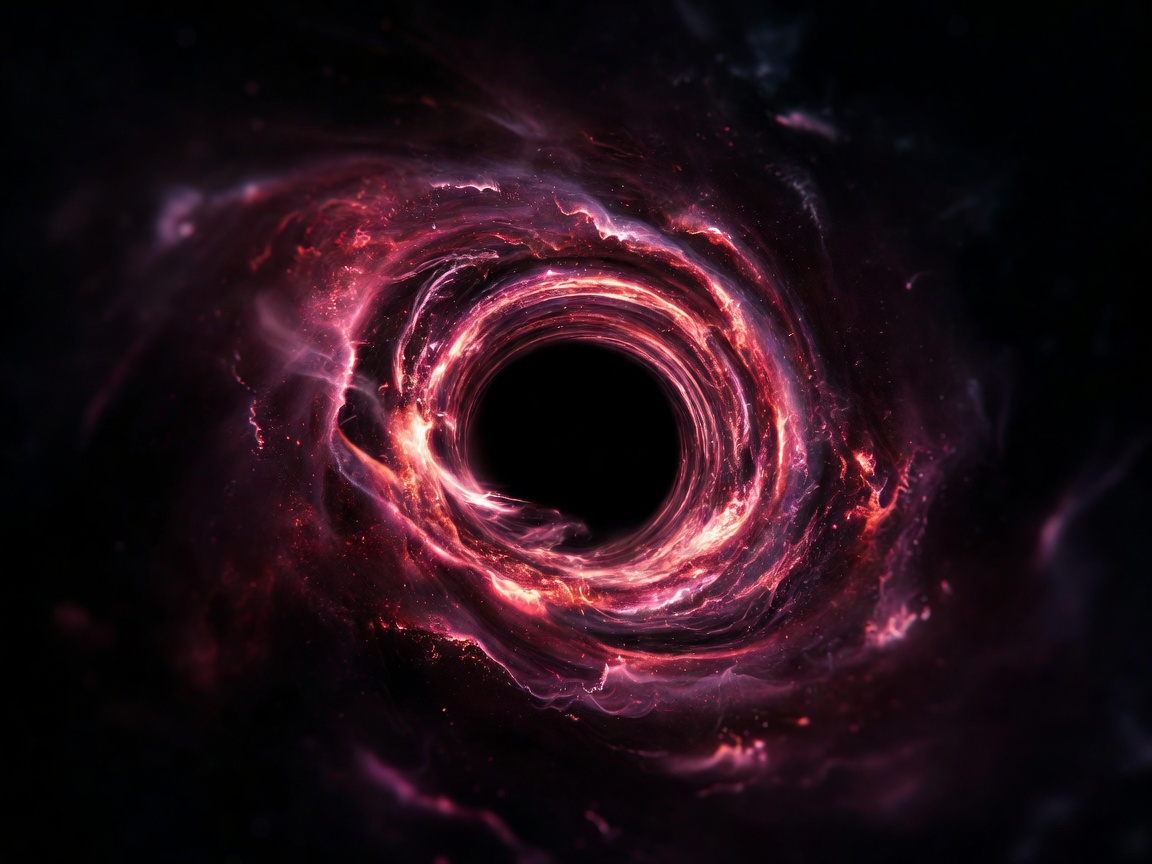
The event horizon is the point of no return. It is not a physical surface, but a threshold. Once matter or radiation crosses this mathematical boundary, its fate is sealed, drawn inevitably toward the center. Time near the event horizon dilates dramatically relative to an outside observer—a phenomenon proven by general relativity.
The Singularity
At the very center of a black hole lies the singularity. Here, mass is compressed down to a point of zero volume and infinite density. Current physics cannot adequately describe what occurs at a singularity; quantum mechanics and general relativity clash fiercely, demanding a new, unified theory of quantum gravity to explain the majestic and terrifying truth of the deep cosmos.